The Dawn of the Post-Browser Era: Kent C. Dodds on MCP Servers, UI Integration, and Building the AI-Powered Future
The way we interact with software is about to change forever. According to Kent C. Dodds—renowned developer educator and creator of Epic AI Pro—we're entering a "Post-Browser Era" where intelligent AI assistants will replace traditional browsers, and websites will evolve into MCP (Model Context Protocol) servers. This isn't science fiction; it's happening right now, and companies across industries are already adapting to this paradigm shift.[^1][^2]
Bidhan Bhandari
December 3, 2025
The Dawn of the Post-Browser Era: Kent C. Dods on MCP Servers, UI Integration, and Building the AI-Powered Future
The way we interact with software is about to change forever. According to Kent C. Dodds—renowned developer educator and creator of Epic AI Pro—we're entering a "Post-Browser Era" where intelligent AI assistants will replace traditional browsers, and websites will evolve into MCP (Model Context Protocol) servers[1][2]. This isn't science fiction; it's happening right now, and companies across indus
tries are already adapting to this paradigm shift.
What is the Model Context Protocol?
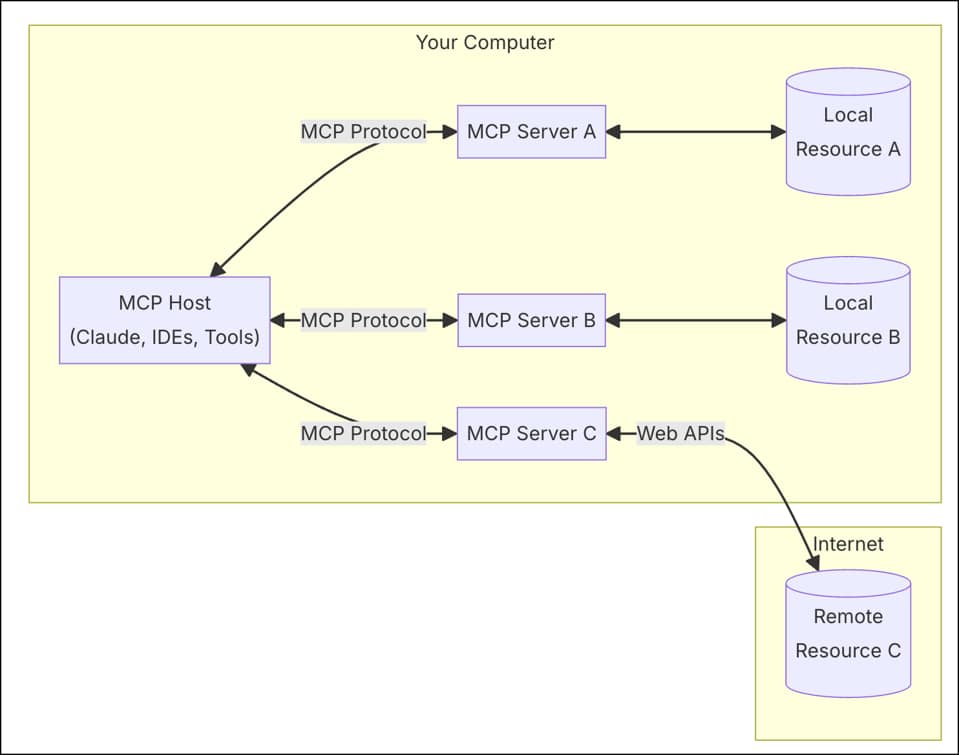
The Model Context Protocol (MCP), introduced by Anthropic in November 2024, is an open standard that enables AI applications to connect seamlessly with external systems, tools, and data sources[20]. Think of MCP as the "USB-C of AI applications"—just as USB-C provides a universal connection standard for electronic devices, MCP offers a standardized way to connect AI models to diverse tools, databases, APIs, and services[8][24].
Why MCP matters
Kent C. Dodds emphasizes that we're witnessing three distinct phases in AI evolution
Phase 1: Simple Chat Interfaces
AI could communicate but couldn't actually *do* anything meaningful. Users could ask questions but had to manually execute the actions themselves.
Phase 2: Limited Integrations
AI assistants gained some capabilities through vendor-specific integrations (like ChatGPT plugins), but each platform required custom development. This created fragmentation and scaling challenges.
Phase 3: MCP - Universal Integration
With MCP, AI can do *anything* because the protocol eliminates integration barriers. Any service provider can build one MCP server that works with *any* MCP-compatible client[5][10][13].
As Dodds explains:
"A Jarvis client will replace the browser. People won't go to URLs anymore. They'll just go to their Jarvis and they'll tell it what they want it to do, and it'll do the thing. The way that it does that is with MCP servers".
The Jarvis Vision: Your Personal AI Operating System
Kent frequently references "Jarvis"—the AI assistant from Iron Man—as the aspirational model for where we're headed. Unlike today's isolated AI tools, a true Jarvis would be:
Omniscient: Connected to all your services, data, and tools through MCP servers Proactive: Understanding your needs and taking action autonomously Multi-modal: Operating across voice, text, and visual interfaces seamlessly Context-aware: Maintaining continuity across all your interactions and workflows Personalized: Learning from your preferences and behaviors to deliver tailored experiences
The infrastructure to build this already exists. As Dodds notes in his talks, "We actually have Jarvis already in the form of a tool that is able to communicate with us and it's even multi-modal. So you can talk to it or you can type to it"[36]. What's missing is the extensive network of MCP servers that give these AI assistants the "hands" they need to interact with the digital world[36].
From Websites to MCP Servers: The New Development Paradigm
One of Dodds' most provocative claims is that websites will eventually be replaced by MCP servers[1][2][5]. Here's why:
Traditional Web Architecture
- Users navigate to URLs
- Interact through graphical interfaces
- Manually click buttons and fill forms
- Each service requires a unique UI
MCP-Powered Architecture
- Users express intent to their AI assistant in natural language
- AI discovers and connects to relevant MCP servers
- Actions execute automatically through standardized protocols
- Services expose capabilities, not interfaces
"If we say the Jarvis replaces the browser, and your website is replaced by MCP servers, then most people are gonna be working on MCP servers," Dodds explains[1]. This doesn't mean visual interfaces disappear entirely—but they become optional rather than mandatory.
MCP-UI: The Best of Both Worlds
Recognizing that some tasks still benefit from visual interaction, Kent has been at the forefront of exploring MCP-UI—an extension that allows MCP servers to deliver interactive user interfaces to AI assistants[2][21][27].
How MCP-UI Works
MCP-UI extends the existing MCP specification with a UIResource interface that enables servers to send structured HTML, React components, or remote-dom specifications back to clients[21][27]. This approach offers several advantages:
Context-Aware Interfaces
AI can generate UI dynamically based on the user's specific situation and needs
Progressive Enhancement
Simple tasks work through pure conversation, while complex workflows can invoke rich interfaces when beneficial
Unified Experience
Users stay within their AI assistant while accessing specialized interfaces from multiple services
Developer Flexibility
Service providers can design optimal interfaces without being limited to text-only responses
In his talk "The New User Interaction Model," Dodds demonstrates building an MCP server with React Router that exposes UI capabilities to AI models[2][18]. This represents a fundamental rethinking of user experience design—instead of designing for direct human interaction, developers design interfaces that AI assistants can intelligently present and manipulate on behalf of users.
Real-World Adoption: Companies Building the MCP Ecosystem
The momentum behind MCP is remarkable. Major enterprises and startups alike are building MCP servers to make their services AI-accessible:
Enterprise Leaders
| Company | MCP Implementation |
|---|---|
| Microsoft | Playwright-MCP enabling AI agents to browse the web and interact with sites autonomously[28] |
| Stripe | Created agent toolkit for commerce, payments, and financial operations[22] |
| PayPal | Developed MCP server for inventory management, payments, shipping, and refunds[22] |
| Atlassian | Integrated Work Graph directly into AI tools for project management[22] |
| Intercom | Connected Fin AI Agent to handle 50%+ of customer support autonomously[22] |
Developer Tools & Platforms
- Linear: Issue tracking and product development workflows accessible via MCP[22]
- Asana: Work management transformed through natural language interaction[22]
- Sentry: Error monitoring and debugging through AI assistants[22]
- MongoDB, Neon: Database operations via standardized protocol[28]
- Cloudflare: Infrastructure and deployment automation[22][35]
Emerging Ecosystem
According to research on MCP adoption, 12% of organizations implementing MCP are enterprises with 10,000+ employees, and grassroots developer adoption is "remarkably strong"[31]. Internal applications are leading the charge, with many companies building MCP servers for in-house tools before public APIs[31].
Technical Architecture: How to Build MCP Servers
Kent C. Dodds has been teaching developers how to build production-ready MCP servers through his Epic AI Pro workshops[7][45][49]. Here are the core components:
Essential Building Blocks
Tools
Functions that AI can invoke with specific parameters
- Must include clear descriptions and argument schemas (typically using Zod validation)
- Should specify metadata:
readOnly,destructive,idempotentflags - Need robust error handling and structured output schemas[49]
Resources
Structured data that AI can access
- Expose files, database records, API responses
- Support dynamic discovery and content negotiation
- Enable real-time updates through change notifications[49]
Prompts
Reusable templates for common workflows
- Guide AI through multi-step processes
- Provide context-specific instructions
- Enable consistent interaction patterns[49]
Authentication & Security
Modern MCP servers implement OAuth 2.1 for secure authentication[1][3][46][48]. This provides:
- User consent and authorization flows
- Scoped access permissions
- Token-based authentication with refresh capabilities
- Support for both individual and enterprise deployments
Companies like WorkOS and Stytch have built specialized authentication infrastructure for MCP servers, dramatically reducing implementation complexity[46][48].
Transport Layers
MCP supports multiple transport mechanisms[10]:
- Standard I/O: Client spawns a process and communicates over stdin/stdout
- Server-Sent Events (SSE): Long-running HTTP connections with streaming
- Streamable HTTP: Modern stateless HTTP protocol recommended for production[24][35]
The Developer Experience: React Integration
Cloudflare and the MCP community have released use-mcp, a React hook that connects to any remote MCP server in just three lines of code[35][41]:
import { useMcp } from 'use-mcp/react'
function MyComponent() { const { state, tools, callTool } = useMcp({ url: 'https://mcp-server.example.com' })
return <div>Your UI code</div>}
This abstraction handles transport protocols, authentication flows, connection management, and retry logic automatically[35][41]. It represents the kind of developer experience that will accelerate MCP adoption across the industry.
The Future: What's Next for MCP?
Kent C. Dodds and other thought leaders in the space see several key developments on the horizon:
1. Dynamic Tool Discovery
Rather than loading every possible tool into the AI's context upfront, future "Jarvis" clients will query dedicated MCP Search Engines to find only the most relevant tools for each request[7][39]. This approach:
- Keeps AI focused and efficient
- Enables personalization based on user preferences and history
- Scales to millions or billions of MCP services
- Reduces token costs and improves response times
2. Agent-to-Agent Communication
MCP enables not just human-to-AI interaction, but AI-to-AI collaboration[10]. Multiple specialized agents can coordinate through MCP servers, each contributing their expertise to complex workflows.
3. Quantum and Neuromorphic Computing
Industry analysts project that quantum-enhanced context processing and neuromorphic computing principles will significantly improve MCP server efficiency—potentially offering up to 50% energy efficiency improvements and dramatically faster processing[23].
4. Federated and Decentralized Networks
Future MCP implementations may leverage decentralized architectures for enhanced privacy and security, particularly in healthcare and finance where data sovereignty is critical[23].
5. Production-Grade Enterprise Features
As MCP matures, expect enhanced capabilities around:
- Advanced security and compliance controls
- Multi-tenant isolation and resource management
- Observability and debugging tools
- Service mesh integration for microservices architectures
How Companies Can Adapt to Build Modern AI-Powered Applications
Kent C. Dodds' vision provides a clear roadmap for organizations preparing for the AI-powered future:
1. Start Building MCP Servers Today
Don't wait for the perfect moment. Begin by:
- Identifying high-value services and workflows in your organization
- Building simple MCP servers that expose core capabilities
- Testing with existing AI assistants like Claude, ChatGPT, or Cursor
- Iterating based on real usage patterns
2. Rethink Your API Strategy
Traditional REST APIs designed for developers aren't optimized for AI consumption. Consider:
- Creating workflow-based tools that guide AI like a UI would guide humans[7]
- Providing rich context and semantic meaning in tool descriptions
- Designing for natural language interaction, not just programmatic access
- Thinking in terms of user intent rather than technical operations
3. Invest in Developer Education
MCP represents a fundamental shift in how software is built. Organizations should:
- Train development teams on MCP architecture and best practices
- Encourage experimentation with AI assistants in daily workflows
- Build internal libraries and templates for common MCP patterns
- Foster a culture of AI-first development
4. Design for the Post-Browser World
While maintaining traditional web interfaces, start planning for AI-native experiences:
- Expose core functionality through MCP servers, not just web UIs
- Design natural language interfaces alongside graphical ones
- Consider how AI will interact with your service on behalf of users
- Build authentication and authorization systems compatible with OAuth 2.1
5. Participate in the Open Ecosystem
MCP's power comes from interoperability. Companies should:
- Contribute to open-source MCP server implementations
- Share learnings and best practices with the community
- Support standardization efforts and protocol evolution
- Build integrations with other MCP-enabled services
The Opportunity: First-Mover Advantage
As Kent C. Dodds emphasizes throughout his talks, we're at an inflection point similar to the early days of the web or mobile revolution[1][2][5][49]. Organizations that embrace MCP early will have significant advantages:
- Market Position: Being discoverable by AI assistants becomes as important as ranking in search engines
- User Experience: Delivering frictionless AI-powered workflows differentiates from competitors
- Developer Productivity: Internal tools accessed via AI dramatically accelerate engineering velocity
- Platform Lock-in Reduction: Standard protocols reduce dependence on any single vendor
The companies building MCP servers today—from Stripe to Notion to Microsoft—are positioning themselves for the post-browser era. Those who wait risk becoming invisible to the AI assistants that will mediate most digital interactions.
Conclusion: Building the Future Together
Kent C. Dodds describes MCP as "the most exciting thing in software development right now"[45][49], and for good reason. The Model Context Protocol represents more than just a technical standard—it's the foundation for a fundamental reimagining of how humans and computers interact.
The vision of Jarvis-like AI assistants seamlessly orchestrating our digital lives is no longer science fiction. The infrastructure exists. The standards are established. Major companies are already building. The question isn't if this future will arrive, but when—and whether your organization will be ready.
"We're entering a new era of user interaction. It's being built right before our very eyes and changing rapidly"[5][13].
The post-browser era is here. It's time to build.
Resources
Learn More About MCP
Watch Kent's Talks
- ["Building Jarvis: MCP and the future of AI" (PodRocket)][1][9]
- ["Letting AI Interface with Your App with MCPs"][5][6]
- ["The New User Interaction Model"][2][18]
- ["The Future of User Interaction with MCP"][13]
Start Building
- Explore MCP servers from leading companies[22][28]
- Try the use-mcp React library[35][41]
- Join the MCP community and Discord[49]
- Take Kent's Master MCP workshop[49]
Written by Bidhan Bhandari
Technology enthusiast and lead writer at Aiversedaily. Exploring the intersection of AI, design, and human creativity.